
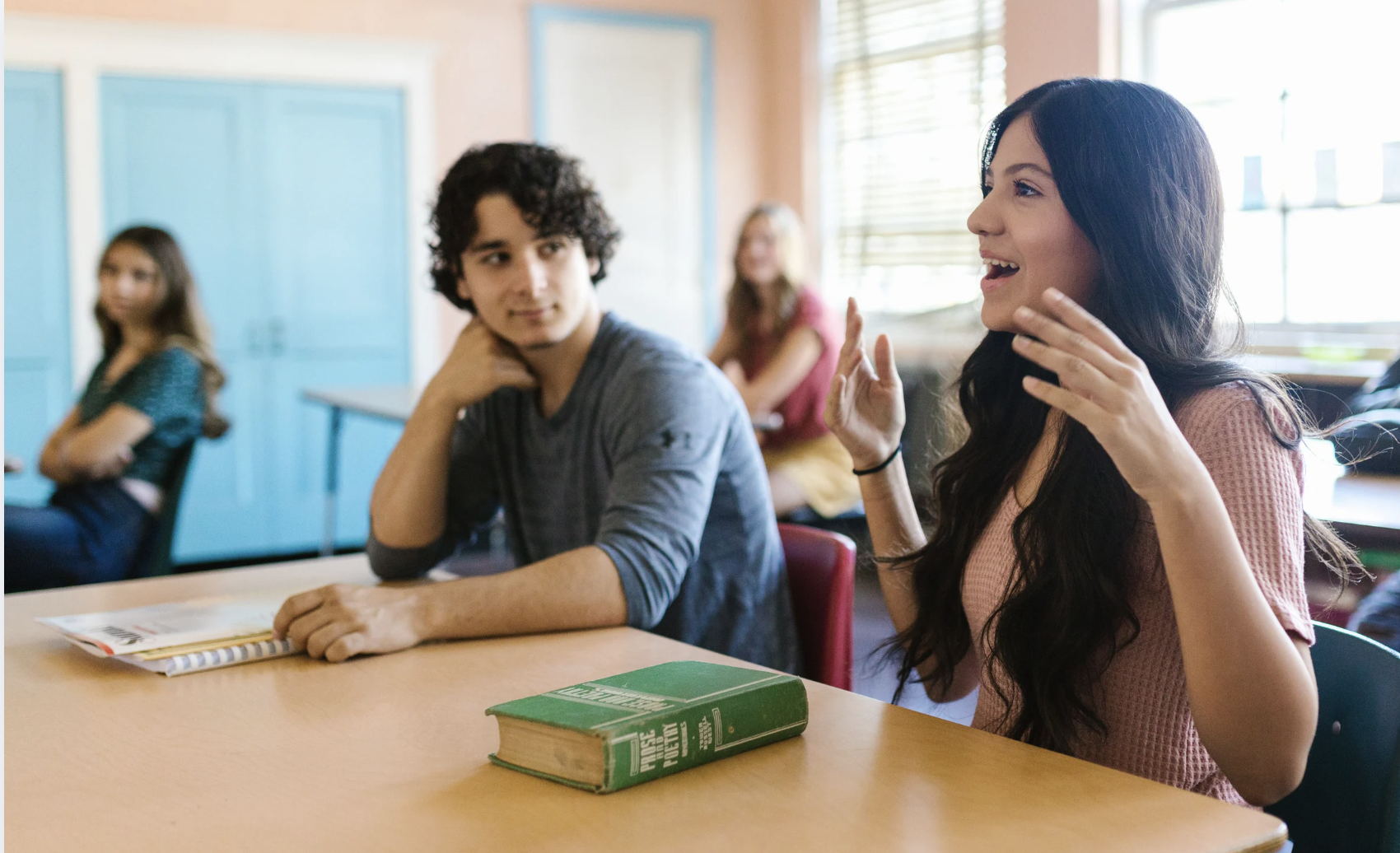
I spend a lot of time in classrooms, and one of the things I love seeing is how many educators are creating opportunities for students to learn with and from one another. Teachers are asking students to turn and talk, work with partners, engage in small-group discussions, and collaborate on projects. These are all incredible opportunities to build community, strengthen relationships, and help students become more engaged in their learning.
But here's something I often notice, and I know that teachers notice too. Just because we ask students to talk to each other doesn't mean they know how to do that in the most academic and responsible way.
I have been there many times myself. As a teacher, I would prompt students to turn and talk and then look around. Some partners would be having a staring contest while others would be looking anywhere but at each other. Other times, students would start talking about what they did over the weekend or what they were having for lunch. During group work, one student might take over while everyone else watched, or students would divide up the work and complete their individual parts without ever really collaborating. The unicorn scenario was effective collaboration that made me say, “Ah, yes, this is totally worthwhile.”
And we all know that sometimes, a whole-group discussion looks more like a game of ping-pong. The teacher asks a question, a student responds, the teacher provides feedback, and then the teacher asks another question. Back and forth, back and forth. This is exhausting for educators!
Now, none of this means that students can't engage in academic discourse or collaborate effectively. It means we have to teach them how, and universal design for learning (UDL) provides a framework for us to do just that.
Academic Discourse and Collaboration Are Skills We Have to Teach
Right now, my son plays youth basketball, so I spend a lot of time on the sidelines watching his coach work with the team. Imagine if the coach simply handed kids a basketball, told them to work together, and expected them to play a great game. That would likely be a disaster. Instead, the coach explicitly teaches skills like dribbling, passing, shooting, and defending. He models what those skills look like, gives the players opportunities to practice, provides feedback, and gradually introduces more complex plays as they develop their skills and learn to work together as a team.
As educators, we need to approach academic discourse and collaboration in the same way.
Academic discourse and collaboration are closely connected, but they require different skills. Academic discourse involves sharing ideas, explaining reasoning, asking questions, considering different perspectives, and building on one another's thinking. Collaboration takes those skills a step further as students work together toward a shared goal, coordinate responsibilities, make decisions, and solve problems together. Students can certainly work together without engaging in meaningful academic discourse, just as they can participate in discussions without actually responding to or building on anyone else's ideas. If we want students to become more independent learners who can engage in complex thinking and work productively with others, we have to explicitly teach, model, and scaffold these skills so students can eventually use them independently.
Universally Designing Academic Discourse
When we universally design instruction, we start with a firm goal and anticipate the barriers that may prevent students from reaching it as we design flexible means. Academic discourse is no exception.
Think about what happens when we ask students to turn and talk without providing any structure. Some students are comfortable jumping right into a conversation, while others need time to process their thinking. Some may have amazing ideas but aren't sure how to enter a discussion, ask a question, or respectfully disagree. We also have students who are learning English as an additional language and others who communicate using augmentative and alternative communication (AAC), sign language, gestures, or other forms of communication. In an inclusive classroom, we can expect this variability and proactively plan for it.
If our expectation is that every student immediately turns to a partner and verbally shares an idea, there are unnecessary barriers that may prevent many students from being able to participate.
The goal of academic discourse isn't simply to get students talking. It's to help students communicate their thinking, consider different perspectives, and construct understanding together. That means we have to explicitly teach what effective discourse looks like and sounds like while also recognizing that communication doesn't look or sound the same for everyone.
The good news is that we don't need to completely redesign lessons to support growth in academic discourse. We can start by making a few intentional shifts.
- Show students what effective academic discourse looks and sounds like. Before asking students to engage in a discussion, explicitly model the skills you want them to use. For example, invite a student to help you demonstrate a conversation where you build on an idea, ask a clarifying question, or respectfully disagree. Then, model a conversation where one person does all the talking or ignores the other person's ideas. Ask students what they notice and work together to identify what makes a conversation productive. Consider co-creating classroom agreements, so students have ownership of the expectations.
- Give students time to think before they talk. Instead of asking students to turn and talk, provide 1-2 minutes of time to think/process/reflect. Encourage them to write down some notes as they think, if they find it helpful. This small shift can make a huge difference for students who need additional processing time, are learning English, or simply feel more comfortable preparing their ideas before sharing.
- Teach talk moves and make them visible. Scaffolds for the win. Before asking students to have academic discourse, explicitly teach a few sentence stems, such as "I'd like to add..." "Can you explain why..." or "I see it differently because..." Post them where students can reference them (or even laminate them on bookmarks!), model how to use them, and challenge students to try one during a partner discussion. As students become more confident, gradually fade the supports so they can use these strategies independently.
- Design multiple ways for students to communicate and respond. Academic discourse doesn't have to mean verbal communication. Students may use AAC, sign language, gestures, writing, typing, or other accessible forms of communication to contribute to a discussion. Make sure partners understand how to communicate with one another, allow appropriate wait time, and create opportunities for reciprocal communication. The goal is for students to share, respond to, and build on one another's thinking, regardless of how they communicate.
Building on Academic Discourse to Strengthen Collaboration
Once students begin developing the skills to share their learning, question, and build on one another's thinking, they can start applying those skills to more complex collaborative tasks. Remember, collaboration isn't simply putting students into groups and asking them to complete an assignment. It's about teaching them to work together toward a shared goal, make decisions, solve problems, and create something that requires everyone's contributions.
Just as we explicitly teach academic discourse, we also need to teach students how to collaborate. Here are three strategies to get started.
- Make the collaborative goal clear. Before students begin working together, make sure they understand what they are working toward and why they need one another to accomplish it. Dividing responsibilities can absolutely be an effective part of collaboration, but if students only complete their individual sections and put them together at the end, they may miss opportunities to learn from one another. Design tasks that require students to consider different perspectives, make decisions together, and combine their contributions to achieve a shared goal. As an example, in an elementary science lesson, instead of having each student research a different animal and its habitat and combine their findings into a poster, have groups design a habitat that could support several animals. Students can research different animals independently, but then they have to share what they learned, consider competing needs, and make decisions together about the habitat's design.
- Explicitly teach collaborative routines and responsibilities. Model how to make decisions together, work through disagreements, and check on the group's progress. These are important life skills that students need to learn and practice. For example, in a secondary history class, imagine students are working in groups of four to develop an evidence-based argument about whether the United States should have entered World War I. Instead of assigning the project and expecting students to figure out how to work together, provide each student with a different primary source to analyze and explicitly teach a collaborative routine. First, ask each student to independently identify a claim and supporting evidence from their source. Next, have students take turns sharing their evidence and explaining their reasoning while the other group members listen and ask questions and agree/disagree. Once everyone has contributed, students can discuss which evidence is strongest and work together to develop a shared argument.
- Build in opportunities to reflect on the process. Throughout a collaborative experience, give students opportunities to reflect on how effectively they worked together. Did everyone have meaningful opportunities to contribute? How did the group make decisions? What happened when someone had a different idea? What would they do differently next time? Students can reflect independently and then discuss their responses with their group to identify what is working and what they want to improve.
Ultimately, we want students to take increasing ownership of both academic discourse and the work they create together. When we explicitly teach these skills and provide flexible supports, we create opportunities for students to move from participating in teacher-directed activities to engaging in increasingly independent, meaningful collaboration.
A New Tool to Support Academic Discourse and Collaboration
One of the things I often encourage educators and leaders to consider is the difference between providing opportunities for academic discourse and collaboration and actually seeing evidence that students are developing these skills. A classroom can be full of conversation without students engaging in deep thinking. Students can be sitting together, sharing materials, and completing a group assignment without truly collaborating. The question isn't simply whether students are talking or working together. It's what they're doing with those opportunities.
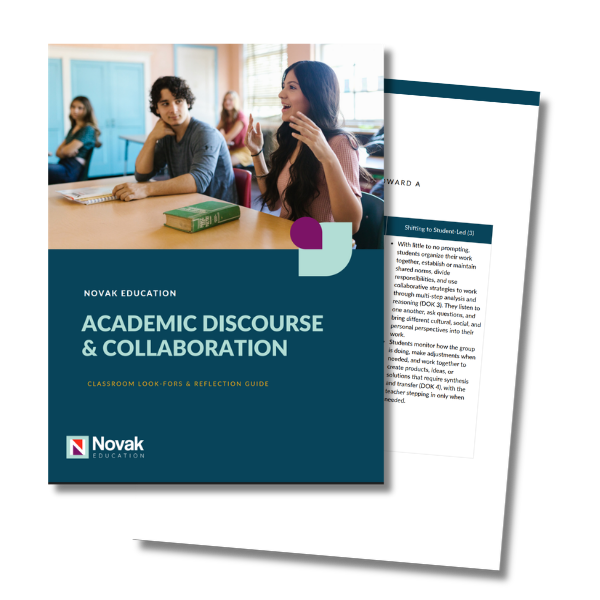
To support this work, we created the Academic Discourse & Collaboration Classroom Look-Fors & Reflection Guide (download below!), a free resource designed for teachers, instructional coaches, and school leaders. The guide focuses on two connected strands: academic discourse and collaboration. Each strand describes what practice can look like as classrooms move from emerging opportunities to more intentional, scaffolded instruction and, ultimately, increasingly student-led learning. The guide also provides a suggested sequence for building these skills over time, beginning with relational safety and foundational discourse skills before moving toward more complex collaborative work.
Most importantly, the guide includes reflection questions to help educators and leaders examine what is happening in classrooms, consider evidence of student learning and participation, and identify next steps.
Because the goal isn't simply to see more turn-and-talks, group projects, or classroom discussions. It is to create learning environments where students know how to communicate their thinking, learn from different perspectives, work through challenges together, and take increasing ownership of their learning.
Download the free Academic Discourse & Collaboration Classroom Look-Fors & Reflection Guide and use it to reflect on how academic discourse and collaboration are developing in your classroom or school. Whether you're just beginning to establish discussion routines or working toward more student-led learning, the guide can help you identify what's working and where to go next.