


Tuesdays and Thursdays for an entire semester, notebook and pen in hand, I would prepare for 90 minutes of lecture on “US History from the Start to 1865.” My professor was an engaging lecturer, and I found myself enjoying the course - until it became time for an assessment. That is when I realized that, despite engaging lectures and mounds of notes, I had actually retained very little, if anything, from the course, and was ill-prepared to use any of that content provided for the higher-order thinking skills required of said assessments.
This experience is not unique to that class or my experience as an undergraduate student, nor is it removed or separate from the experience that many K-12 students have today, particularly secondary students. In fact, throughout the wide range and quantity of classrooms that I visit, some version/form of lecture still dominates our students' educational experiences. Often, after a classroom visit, when working with a teacher, or during a Q&A session when delivering professional development on Universal Design for Learning (UDL), I get asked, “So what? Now I can no longer actually teach my students? I am just supposed to give them articles, videos, and podcasts, and no longer teach?” I get it; when we start talking about providing choices for how students can learn, it can feel as if “lecture” is no longer okay. Here is the key: there is a huge difference between traditional lecture and universally designed direct and explicit instruction.
John Hattie’s research helps us better understand the distinction and impact (or lack thereof) of these two teaching methods when we look at effect sizes. An effect size is a way of measuring the magnitude of an impact on student learning. Generally, positive effect sizes indicate improvements in learning, while negative effect sizes suggest less favorable outcomes. Hattie uses an effect size of 0.40 as a benchmark for approximately one year of learning growth. Traditional lectures, defined as essentially uninterrupted presentations to passive audiences, actually have a negative average effect size associated with student learning (-.33). However, direct instruction and explicit teaching have effect sizes associated with student learning of .56 and.63, respectively.
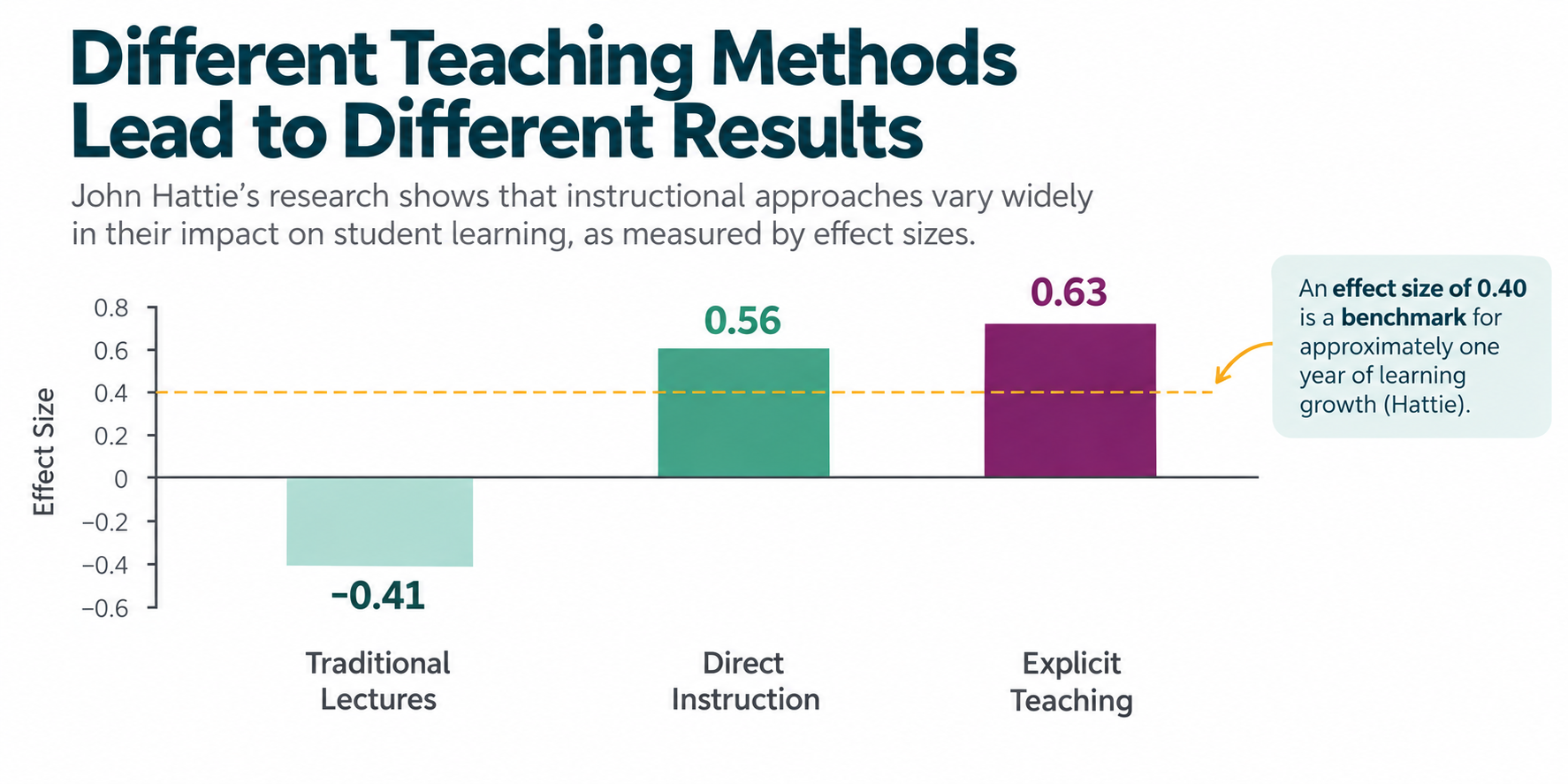
It's important to distinguish between these terms. Explicit instruction is when teachers explain and model concepts and skills, provide guided practice and feedback, check for understanding, and gradually support students in applying their learning independently (I do, we do, you do). Direct Instruction (capitalized) is a structured model associated with Siegfried Engelmann. It uses scripted instructional routines and frequent opportunities to respond and interact. You can learn more about Engelmann’s model here. Direct instruction (lowercase) is now used more broadly to describe teacher-led instruction and is often conflated with explicit instruction, but technically they are not the same thing. Hattie reports direct instruction and explicit teaching separately.
With that said, one point must be made clear: UDL does not mean we stop “teaching” in the traditional sense, but it does mean we need to rethink those traditional lectures and replace our time in front of students with targeted and purposeful explicit instruction.
Here are five tips to help you transform your teaching and help all students better access and understand their learning.
1. Chunk the Time
This might be both the quickest and easiest way to make a small change with huge rewards. In their study, “How students learn best” (Australian Education Research Organisation [AERO], 2023), the Australian Education Research Organisation provides four key takeaways on student learning, and one of them is that “students process limited amounts of new information.” They go on to note that teachers must provide new information in more manageable parts with processing pauses along the way. So, instead of talking at students for 20-30 minutes and then asking, at the end, “if there are any questions,” consider breaking your explicit instruction into smaller segments with processing pauses along the way. As a general rule here at Novak Education, when we do professional learning workshops with educators, we aim for a two-minute pause roughly or every ten-minute block of content/instruction.
2. Pause with Purpose
As noted above, chunking the instruction into smaller segments is one quick and easy way to help increase student learning, but it is what we do with those pauses that really can empower students to digest, process, and retain the information being presented. Here are a few ways that we can empower students to own their learning by having the time and space to make it their own.
- Pause and ask students to write down the three most important things they heard during that last chunk without looking at their notes.
- Ask students to turn to a partner and explain the concepts just shared in that chunk.
- Have students draw a visual representation of what they just learned
- Invite students to give a “real-world” example of the concept taught in the recent chunk.
- After modeling a problem, give a pause for students to attempt to solve a similar problem on their own without using their notes.
- Have students pause to connect something from this chunk to the previous day or unit’s learning
Each of these moves provides students with a safe space to process the information, make it their own, learn from and with others, and deepen their understanding of the chunk at hand before having to digest more new information remaining in the lesson.
And if we really want to do our best to remove barriers for students, we can give them a few choices for how to process during the pause, and then after having tried a few different options, they can reflect upon which works best for them and which doesn’t. This is the sort of learner agency we are really trying to build.
3. Stop Confusing Taking Notes with Learning
I often see teachers who use traditional lectures asking/requiring their students to “take notes,” and when I do, I often see students either feverishly writing down everything that is on the slides that the teacher is using or filling in blanks on a packet they were given. Neither of these tasks actually requires cognitive engagement with the material being presented. As I often joke during my PD sessions, a student can literally be mentally thinking about their fantasy football team and still copy down words from a teacher's slides.
Instead, we should be rethinking “taking”notes all together and push our students to be “making” notes. When we flip the conceptualization from taking notes to making them, teachers can actively spend time helping students understand multiple ways to process, digest, and record what they are hearing/seeing in meaningful ways that matter to their own ways of thinking and lives. Then, we can empower students to practice these varied methods for note-making, having them reflect upon which method works best for them moving forward. Using something such as Cornell notes is one great way to ensure that students are cognitively engaged, as one cannot complete that type of note simply by copying. They are forced to think, process, and make sense of the material.
Here are a few other ways students can learn to take notes that require deep cognitive thinking.
- Connection Notes: how does this connect to previous learning?
- Comparison notes: how are these concepts connected? Different?
- Cause and Effect notes: this led to that because…
- Summary notes: taking a chunk and putting it into my own words
- Sketchnotes: using images woven with key words/phrases
Each of these types of notes carries with it the cognitive engagement we want of our students, and over time and with reflection, students can begin to best understand which method works best for them given the learning context at hand. For additional thinking protocols that can help students in making notes and help you deepen the cognitive ask of your explicit instruction, check out Project Zero, Harvard Graduate School’s work on supporting deeper thinking with a wide range of routines for your classroom.
5. Rethink the Design and Use of Your Slides
Less is more. Most of us have probably heard of the 4x4 or 5x5 rule of slide design (4 points with four words per point), and if not, here is a great resource for slide design that covers that rule and so much more about making your slides as accessible as possible. Designing with this in mind and avoiding full, lengthy sentences also “forces” students to listen with intent while still providing support along the way. Also, how we use our slides can help support student learning during our explicit instruction. Instead of asking students to listen to you AND write down information at the same time, you can say to students, “Listen to me for a few minutes, and then I will give you time to add this new content to your notes.” This helps students stay focused on what you are saying while also providing them the time and space to make meaning of what was said. You can support this practice by providing students with the option of having a print or digital copy of your slides in front of them, too.
6. Consistently Embed Reflection to Develop Learner Agency
While we have zero control over whether our students will eventually end up in a course such as the US History course I opened with, we do have total control over whether or not we have prepared our students to best navigate that sort of course. As mentioned here and there throughout this piece already, giving students choice is a great thing, but ultimately, choice, in and of itself, is not the goal; choice is a vehicle by which we can reduce barriers to learning and help students develop learner agency and work toward mastery of grade-level standards when it is paired with consistent self-reflection. Students will not know which type of note-making strategy works best for them until they are taught multiple ways, given chances to use each, and invited to reflect on how each one impacted their learning. Similarly, they will not inherently know which processing move/prompt works best for them until they have tried multiple options and reflected upon the impact of each on their learning. But when we start adding in these moments for reflection, students begin to better understand how they learn best in the wide range of learning environments they do and will face. Ultimately, that is the goal.
The goal, therefore, is not to move away from teaching, but to recognize the powerful role we play in designing and facilitating learning. By shifting from traditional lectures to intentional and accessible explicit instruction, meaningful reflection, and opportunities for students to take ownership of their learning, we can foster deeper engagement and learner agency. In doing so, we empower students to become more independent, resilient learners who have the skills and confidence to navigate learning throughout their lives.
After 20 years in public education and now six years as an educational consultant, I honestly look back and wonder what those Tuesdays and Thursdays in US History could have been…. What if I had been given time to process what I was hearing, opportunities to retrieve and apply what I was learning, and chances to reflect on which strategies actually helped me make sense of the content? My notebook might have looked different, but more importantly, my learning would have, too!
As educators, we cannot go back and redesign the learning experiences we had as students. But we can use those experiences to rethink the ones we create for our students today. The goal isn't simply to get information in front of them. It's to design instruction that helps them do something meaningful with it—and equips them to take greater ownership of their learning long after they leave our classrooms.