

Over the summer, my son, who was about to enter sixth grade, was assigned a summer reading project. The assignment included completing a graphic organizer to reflect on passages from the text he found impactful and answering questions about the characters' decisions, emotions, and obstacles.
Writing is a struggle for my son. It makes him anxious, and he has some markers of dyslexia that make decoding and spelling particularly challenging. Eager to get the assignment off his plate, he often responded with the bare minimum: “The character felt sad because he was scared he would lose his friend.” No details. No elaboration. I tried encouraging him to add more context and supporting details, but he wasn't having it. As far as he was concerned, he had answered the question and met the requirements.
Oh, how I wish he'd had access to some exemplars! Seeing examples of thoughtful, well-developed responses could have helped him understand what success looked like and given him a clearer sense of how to get there.
The problem wasn't that he didn't understand the question or couldn't come up with an answer. He simply didn't recognize the difference between an answer that was technically correct and one that demonstrated deeper thinking. This is a common challenge in classrooms. We ask students to explain their reasoning, support their ideas with evidence, or provide thoughtful reflections, but how often do we actually show them what that looks like? Even when our learning objectives are clear, and success criteria are laid out and incorporated into a rubric, students can struggle to understand what high-quality work looks like.
This is where exemplars can make a meaningful difference. When used intentionally, exemplars can serve as powerful instructional scaffolds, helping students recognize what quality looks like, understand how to approach complex tasks, and develop the skills to evaluate their own work.
But the goal isn't for students to rely on exemplars forever. The goal is to help students develop the expertise and confidence to succeed without them.
What Makes an Exemplar a Scaffold?
A scaffold is a support that helps learners accomplish something they may not yet be able to do independently or navigate a complex or unfamiliar task more effectively. Some scaffolds are gradually removed as learners develop proficiency, while others remain valuable resources that learners can access independently when needed.
For example, even experienced writers consult exemplars when submitting articles to unfamiliar publications. In fact, reputable journals often encourage authors to review previously published work to better understand expectations for style, structure, and tone. The goal isn't to become so proficient that exemplars are no longer necessary. It's to know when and how to use them strategically.
For example, imagine students are learning to write persuasive arguments. A teacher might share a strong example of an argumentative paragraph that includes a clear claim, relevant evidence, and reasoning that connects the evidence to the claim.
Simply showing students the paragraph is modeling. But when the teacher helps students examine its features, understand why those features are effective, and apply that understanding to their own writing, the exemplar becomes a scaffold.
Students aren't being asked to copy the example. They're learning to recognize the decisions that make the work successful. This distinction matters because effective scaffolding supports thinking rather than replacing it.
How Exemplars Support Universal Design for Learning
Universal Design for Learning (UDL) encourages educators to anticipate barriers and design flexible learning experiences that support learner variability. One predictable barrier is that students may not understand what success looks like, even when they understand the learning goals and instructions.
Consider the difference between telling students to "provide a thorough explanation" and showing them different examples of explanations with varying levels of detail, evidence, and reasoning. The second approach makes an abstract expectation more concrete.
Complex assignments often require students to make many decisions simultaneously. They must interpret directions, organize ideas, select strategies, manage resources, and monitor the quality of their work.
An exemplar can reduce some of that uncertainty by making the structure or characteristics of successful work more apparent. For example, students creating their first research presentation might benefit from reviewing a strong presentation and discussing how the information is organized, how evidence is presented, and how visuals support the message.
The exemplar doesn't do the thinking for students. It helps them direct more attention toward the thinking that matters.
Exemplars become especially powerful when students use them to evaluate their own work. Rather than depending exclusively on teacher feedback, students can compare their work with established success criteria and examples of quality.
They might ask:
- What features of the exemplar are also present in my work?
- Where does my work differ, and why?
- What choices did the creator make that contributed to the quality of the work?
- What is one change I could make to strengthen my work?
These questions shift the exemplar from something students observe to something they actively use to monitor and improve their learning.
Putting Exemplars into Practice: The Bump It Up Wall
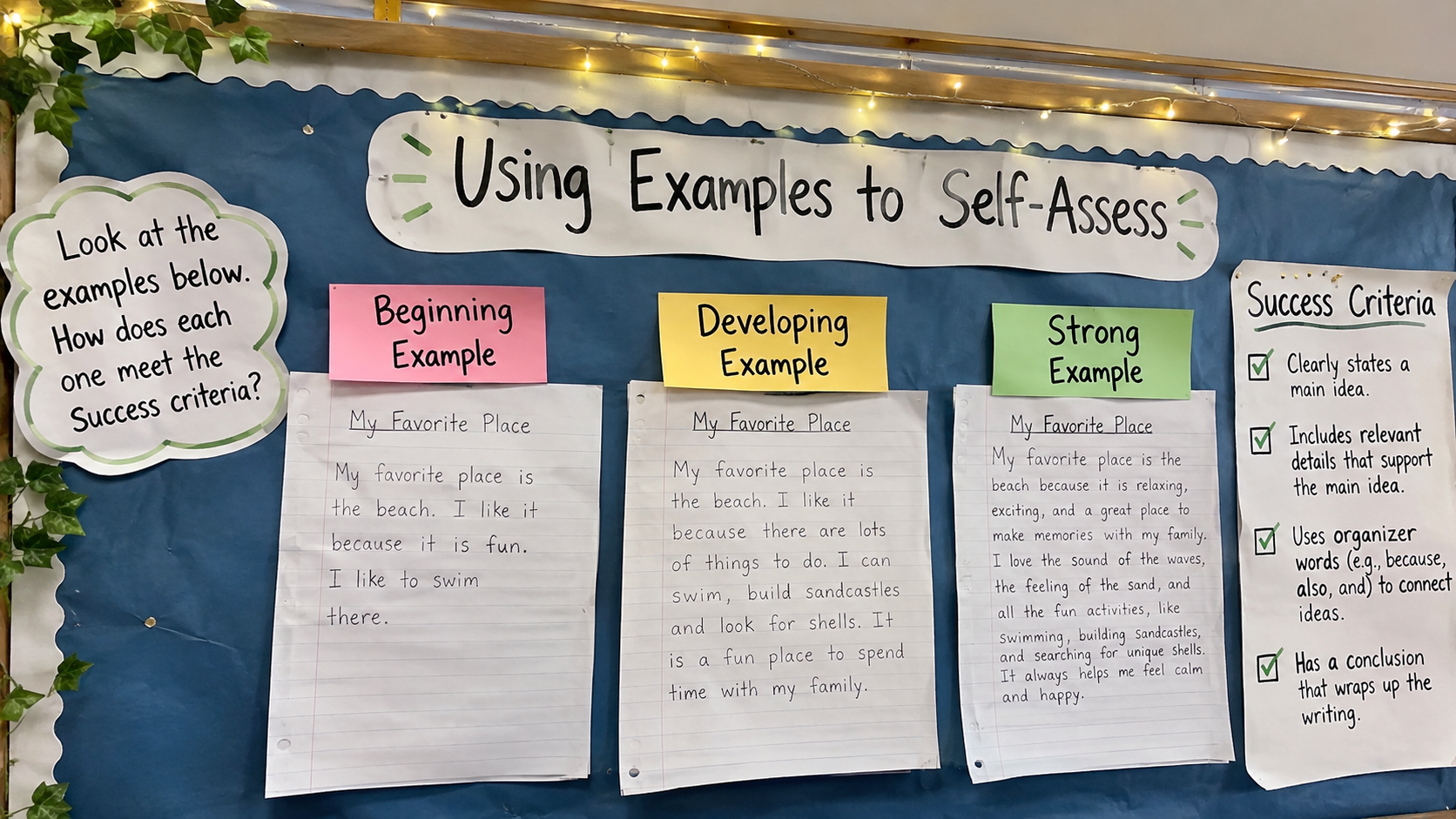
One practical way to use exemplars as scaffolds is through a Bump It Up Wall, a classroom display that features examples of student work at different levels of quality. Rather than showcasing only exemplary work, a Bump It Up Wall makes the progression toward success visible, helping students recognize what they can do to strengthen their own work.
For example, imagine a teacher displaying three responses to the same reading comprehension question. The first provides a basic answer, much like my son's summer reading responses. The second includes additional details and evidence from the text. The third goes further, explaining how that evidence supports the student's interpretation.
By comparing the responses and discussing what makes each one more effective, students can begin to identify specific strategies for improving their own work. Instead of hearing "add more detail," they can see what meaningful elaboration actually looks like.
The real power of a Bump It Up Wall comes when students use it as a resource throughout the learning process. They can examine the examples, compare them with their own work, and identify one or two changes that would help them move closer to the learning goal.
And as students become more confident in recognizing and producing quality work, they may find they no longer need to reference the wall as frequently.
This is scaffolding in action: making success visible, supporting students as they work toward it, and gradually building the skills to evaluate and improve their work independently.
How to Use Exemplars Without Encouraging Copying
A common concern is that students will simply imitate the exemplar rather than develop original ideas. That concern is reasonable, particularly when an exemplar is presented as a finished product without discussion. The solution isn't necessarily to withhold examples. It's to be intentional about how students engage with them.
One important strategy is to share exemplars that demonstrate the same skills and expectations without responding to the exact assignment students will complete. For example, if sixth-grade students are writing an evidence-based argument about whether schools should switch to solar energy, they might analyze a published argument about banning smartphone use in schools. Students can examine how the writer establishes a position, integrates credible evidence, addresses counterarguments, and uses reasoning to connect evidence to claims. They can then apply those same techniques to their own arguments without borrowing the exemplar's ideas or content.
While reviewing the exemplar a teacher might ask:
- "What makes this explanation convincing?"
- "How does the author organize the evidence?"
- "Which elements are essential for success, and which reflect the creator's personal choices?"
These conversations help students distinguish between the characteristics of quality work and the specific features of an individual example. This encourages students to transfer the underlying strategies rather than reproduce the content.
From Scaffolding to Agency: When Should Students Use Exemplars?
One of the most important goals of effective scaffolding is to help learners develop greater independence. While some scaffolds may be gradually faded as students develop expertise, others remain valuable resources that learners can use strategically.
Students develop expertise at different rates, and the supports they need may change depending on the task, context, and expectations.
Rather than removing exemplars according to a predetermined schedule, educators can help students evaluate whether they still need them.
Consider a progression:
Explore
Students examine exemplars with teacher guidance to identify characteristics of quality.
Apply
Students reference exemplars while completing their own work, using them to inform decisions about structure, content, and approach.
Evaluate
Students compare their work with success criteria and exemplars, identifying areas for improvement.
Select
Students recognize when an exemplar would be useful and independently decide whether and how to consult one.
Transfer
Students apply their understanding of quality across new tasks and contexts, independently seeking out exemplars when they encounter unfamiliar expectations.
This progression isn't necessarily linear. Students may move between stages as they encounter unfamiliar tasks or increasingly complex expectations. The key is to make the decision to use a scaffold part of the learning process.
For example, a teacher might ask:
"What could help you evaluate the quality of your work? Would it be helpful to revisit an exemplar, use the success criteria, seek feedback, or try another strategy?" Over time, students learn to recognize what they need, select appropriate resources, and evaluate whether those resources are helping them make progress.
This is an opportunity to build metacognition and learner agency. When we empower students to understand the why and how around using exemplars, they aren't simply learning how to complete an assignment. They're learning how to recognize what they need to be successful.