

I am weeks away from leaving a place that has marked my career. One of those places that shapes your life, for the people you get to share everyday moments with, for the families you support, and most of all, for the children.
Lately, I have been thinking about the best way to break the news to them, while carefully packing away the LEGOs we’ve bought over the years (more than 100 sets!). Deciding what makes the cut and what gets left behind, I realize I am boxing up my life for yet another new beginning. As I sort through the resources, I find myself sorting through the memories, too, watching them replay in vivid color. Suddenly, all the feelings hit.
Excitement for the new memories I will create with my family. Confusion about leaving when everything feels comfortable. Fear of making a mistake. Anxiety about what this change will bring. Sadness for leaving behind everything I have built with the community around me. Curiosity for what is coming next.
Everything feels like it’s too much.
On top of that, there is the tiredness that arises from a full year of supporting educators around the world. That exhaustion adds another layer to the complexity of this moment.
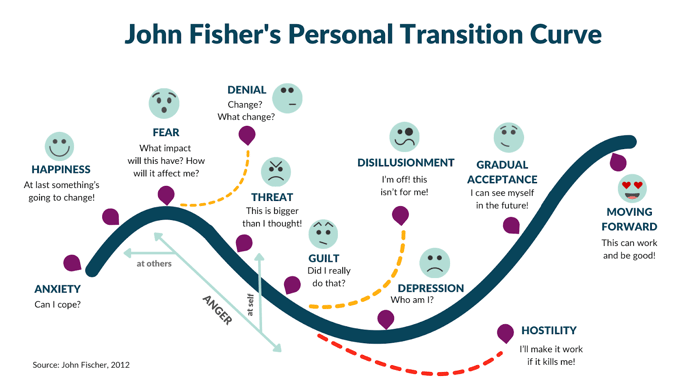
This is where Fisher’s Personal Transition Curve (2012) becomes a lens. By mapping emotions, thoughts, and responses to different phases of transition, it allows me to move from simply experiencing change to understanding it. In doing so, I can begin to anticipate not only my own responses, but also the range of experiences my students may be navigating. It invites me to be intentional about making explicit connections between my feelings, the way I think, and how to cope with change.
Where do we start?
As teachers, we tend to direct all our attention toward our students. We ask ourselves:
- What do they need right now?
- How can I ensure they end the year smoothly?
- How can I minimize disruptive behaviors?
But sometimes we forget that students experience what we project. Our emotional state inevitably shapes the classroom culture.
A more helpful place to begin might be with a self-check:
- What am I doing to end this year successfully?
- Am I coping well with this transition?
- If not, what could help?
- Who can I reach out to for support?
This kind of reflection allows us to approach the transition with greater awareness.
As Brené Brown writes in Atlas of the Heart:
“Without understanding how our feelings, thoughts, and behaviors work together, it’s almost impossible to find our way back to ourselves and each other”
Brown’s research shows that vulnerability is the birthplace of belonging, an essential component in building classroom cultures where supporting one another is the norm.
Taking time to check in with ourselves and recognizing when we might be dysregulated requires courage. It means allowing ourselves to be vulnerable enough to acknowledge that, at times, we might unintentionally become a barrier to creating the supportive environment our students need during transitions.
From Within to Maximize Impact on my Students
What I am beginning to understand is that I am not moving through this transition alone, my students are moving through it with me, reading every pause, every shift in energy, every decision I make. The way I hold this moment becomes the ground beneath their feet. When I feel rushed, they feel unsettled. When I create clarity and consistency, they feel safe. This is where the shift happens: from simply managing my own experience to intentionally designing theirs.
By taking time to name my emotions, maintain the routines we’ve built, and seek support when needed, I begin to translate my internal process into external structures my students can rely on. Predictability, reflection, and choice are no longer just strategies; they become anchors that reduce uncertainty and sustain belonging. From a UDL lens, this is the work of minimizing barriers while honoring learner variability during moments of change.
And in that space, UDL becomes more than a framework, it becomes a way of turning self-awareness into intentional design, ensuring that even in transition, every student feels held, seen, and ready for what comes next.
A Toolkit to Support the End of the Year (From a UDL Lens)
Transitions can be complex for learners. From a Universal Design for Learning (UDL) perspective, the goal is to reduce uncertainty, sustain engagement, and maintain learner agency as the year comes to a close.
Here are some strategies educators can use to support students during this time.
1. Make the Transition Visible
Uncertainty can create anxiety for many students. Providing clarity helps reduce cognitive and emotional load.
Consider:
- Visual timelines for the final weeks of school
- Countdown calendars of important events
- Clear explanations of what will happen next (next grade, next teacher, next routine)
Predictability supports students who rely on structure to feel safe.
2. Invite Reflection and Closure
Students benefit from recognizing their growth.
Possible strategies:
- Learning portfolios
- “Look how far I’ve come” reflections
- Celebrating progress rather than just outcomes
Reflection supports metacognition and learner identity, key components of agency.
3. Provide Multiple Ways to Express Goodbyes
Not every student processes transitions the same way.
Offer flexible options such as:
- Writing letters to the class
- Drawing memories from the year
- Recording short messages
- Creating collaborative memory walls
Providing choice honors learner variability.
4. Maintain Core Routines
Even when the end of the year feels hectic, maintaining familiar routines can provide emotional stability.
Small things matter:
- Morning meetings
- Reflection circles
- Consistent transitions between activities
These routines reinforce the sense of safety students rely on.
5. Support Future Readiness
Transitions are opportunities to build independence.
Provide options for students to prepare by:
- Discussing strategies that help them learn
- Identifying supports that work for them
- Practicing self-advocacy
This helps students carry forward tools that will support them in the next stage of their learning journey.
The Journey Ahead
The hope of what’s coming is now something I am trying to focus on more. I can see now how end-of-year transitions are rarely simple. They are filled with emotion, reflection, and change.
But when we approach them intentionally, taking care of ourselves while designing supportive experiences for our students, we transform this moment into something powerful: a bridge between what was and what is yet to come.
And sometimes, that bridge is built with reflection, vulnerability, some poetry along the way and maybe even a few LEGO sets carefully packed.
“Respirar es también hacerte cargo de tus sueños” “Breathing also means owning your dreams”
Lina Botero. Colombian poet