
From the student who arrives on three hours of sleep to the one who clearly just finished a Mountain Dew, teachers deal with a lot that is simply out of our hands. Throw in shifting district initiatives, budget crises and "this could have been an email" PD sessions, and it’s easy to feel like you are simply a passenger on this journey. While we can't fix the budget or the bus schedule, we can control the four walls around us. Finding aspects of teaching within our control can seem difficult at times, so when we identify something that we actually can control, it is important that we maximize the opportunity. How we intentionally set up our classrooms can actually make a difference for our students. Although it may not seem like a big thing, the research may surprise you.
When we talk about inclusive practice and Universal Design for Learning, the focus is typically on the instructional end, specifically the interaction between staff and students. In our district, we have been very fortunate to recently complete a new middle school. Throughout the building process, we worked with architects to create inclusive environments based on scientific research.
We began to have a much clearer picture of how classroom design can affect the student experience. Maintaining these spaces in an inclusive way isn’t as easy as one might think. Each teacher has their preferences over how they decorate and set up their classroom, and while we never want to diminish those wonderful personalities, we have identified opportunities to align our vibrant classroom setups with concrete findings in environmental psychology.
Throughout our work, we have identified several actions and strategies that can lead to improved student results. While this is not a comprehensive explanation of all that can be done to enhance our learning environment, we sought to identify a number of factors that we commonly see in today’s classrooms.
The Power of Natural Light
One specific area of focus is access to natural light. In observations around the country, it is common to see shades pulled down and overhead lights off. The research refers to the use of fairy lights (mini holiday lights) as a popular way to offer some light and although they do look nice, they just don’t quite provide the illumination needed for quality learning. Often, this is a thoughtful attempt by teachers to create a "calm" atmosphere and assist in managing behaviors.
However, research from the Heschong Mahone Group found that students in classrooms with the most natural light progressed 20% faster on math tests and 26% faster on reading tests over one year compared to those with the least. While dimming lights is a well-intentioned strategy for regulation, natural light is actually the most effective biological signal for focus, mood, and circadian rhythm. If you have it, use it! Light is our friend as educators.
Curation over Clutter: Managing Cognitive Load
As humans, our ability to focus is a finite resource. Cognitive Load Theory teaches us that our senses are constantly accepting information, and all inputs, whether sight, hearing, or something else, compete for our attention.
A 2014 study from Carnegie Mellon University found that children in highly decorated classrooms were more distracted and demonstrated smaller learning gains than those in more streamlined environments. Lead researcher Anna Fisher noted, "A classroom's visual environment can affect how much children learn." Our classrooms often reflect our passions, from Harry Potter posters to local sports flags. These "sparks of joy" are wonderful and can be helpful in making connections with students, but we must ensure they don't cross the line into "visual noise" that taxes a student's neuroprocessing bandwidth. Decor should be purposeful and designed to support the learning process, providing "resting places" for the eyes rather than constant competition for focus. At the other extreme are classrooms devoid of any decor. This, too, can negatively affect student learning. We need to find the happy medium. Numerous studies and educational articles state that leaving some wall space (between 20% and 50%) empty, especially the space where the majority of instruction occurs, helps to reduce distractions.
Maximizing Classroom Real Estate
If you are an administrator, we suggest visiting your classrooms in the quiet of the early morning or late afternoon. When the students are gone, you can get a better feel for the intentionality of the design. You might notice things like countertops piled with stacks and stacks of papers, a "packrat" corner of old projects, furniture brought in from home that probably should have been trashed years ago, and many other things that may not be evident during a busy school day.
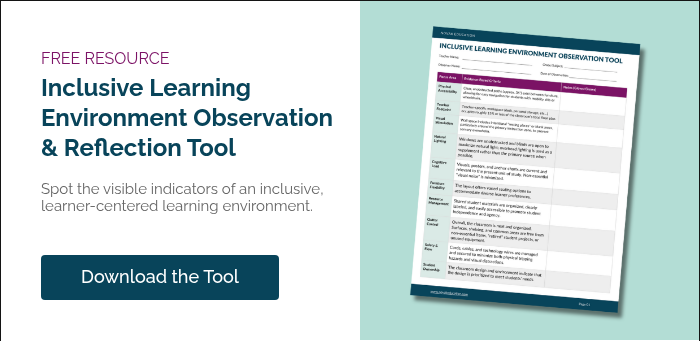
For our hardworking staff, we encourage you to take a "brave look" at your space. Consider these questions with a self-evaluating, asset-based eye:
- Does the classroom optimize physical mobility? We know that fitting 30 desks into a room is a Herculean task. However, ask yourself: "If a student utilized a wheelchair, could they navigate this space?" If the answer is no, it may be time to reclaim some square footage if possible.
- Is the teacher's footprint minimized? Think of your classroom as prime real estate. Ideally, teacher-specific space (desks and personal items) should comprise less than 15% of the room, leaving the rest for student collaboration and movement.
- Are storage areas utilized efficiently? As educators, we are naturally resourceful, often saving materials "just in case." But those 10-year-old replicas of ancient Rome created entirely of old toilet paper rolls might be standing in the way of today’s innovation. If it hasn’t been used in the last year or two, it’s likely “visual noise” or simply taking up valuable storage space. Let it go!
A Cathartic Change
We are not encouraging anyone to conform to a sterile, "one-size-fits-all" norm. However, just as a restaurant or business conveys a certain "vibe," our classrooms should signal that student focus and accessibility are the priorities.
There are few things more cathartic than a good "clean out." By taking an honest look at our teaching spaces, we gain the opportunity to control one more variable that affects learning. Doesn’t that sound like a pleasant change?