


I like to exercise, and I love playing sports, but working out or running are almost a form of torture on their own. I could play soccer for 2 hours, and my heart will be racing an almost unhealthy amount, but four minutes on a treadmill feels like it will never end. Tell me we’re playing 36 holes of golf today and walking them; I’m in. But spend 30 minutes in the gym kicking my own butt? I'll avoid it every chance I get.
Most of us have some version of this. We all have things we want to do and things we have to do in our lives. Our students are no different. School can feel like a lot of have tos. We do our best to dress it up, to make it fun, but how many of us, when asked, “Can we go outside?” Or, when someone asks, “Can we play that game?” respond with some version of “No, we have to _____,” because, for us, too, as teachers, there are things we have to do. We have to get through our curriculum pacing guides, complete district assessments, take attendance, etc.
Want tos are those things that can engage us for a long time because the act of doing sustains us. Thus, two hours of soccer feels like 30 minutes, and 4 min of running feels like an eternity. The same thing occurs in our classrooms. The problem isn't that students don't care about learning. It's that we've often designed learning around obligation rather than engagement. Often we make that design choice because that is a) what we know and b) what works for us as learners. Not all learners respond to obligation-based motivation.
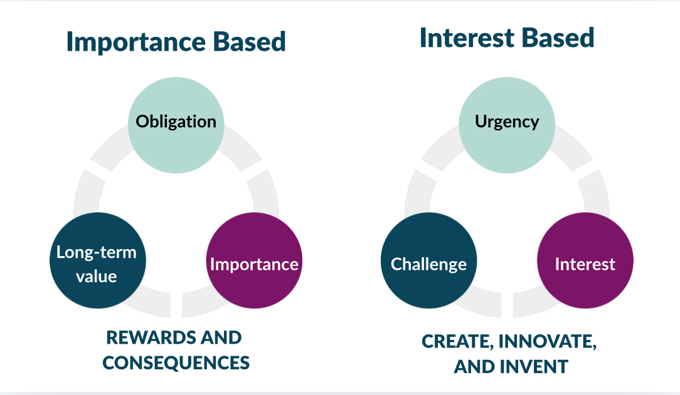
Researchers who study ADHD often describe motivation as operating differently than it does for many neurotypical learners. This is because neurotypical brains often have an importance-based motivation system, motivated by rewards and consequences. These could be things such as due dates, deadlines, grades, or parental expectations. In other words, they are motivated because it’s important, an obligation, or a long-term value.
Neurodivergent brains, by contrast, are motivated by an interest-based system. They are more likely to be motivated by creation, innovation, and invention. This might look like something novel or challenging or something that aligns with their interests. They are also motivated by urgency. For many ADHD students, this may be why the assignment we give isn’t completed until the urgency reaches a point that creates a challenge. The assignment or task itself wasn’t novel or interesting enough to create engagement, or conversely, the challenge felt too great to even start. (That’s a different piece of the puzzle that requires scaffolding rather than motivation, a topic worth its own deep dive)
The good news is that, armed with this information, we can design learning experiences that meet the needs of ALL our students.
If we, as learning designers, want to create an environment where all students can succeed, we have to consider the motivational factors for our ADHD students. That means our job isn't to make students more motivated; it's to design tasks that already contain the things that motivate them: novelty, challenge, and choice. Here are a few things you could do:
Offer Choices and Variety
- Allow students to demonstrate mastery in different ways. If working toward a content standard where students have to explain, summarize, analyze, etc, they don’t all need to write a paragraph. Instead, offer choices such as writing a paragraph, giving a presentation, creating a poster, or recording a podcast.
- If the goal is writing, then students must write!! Consider different genres. An argument could be a speech, a letter to the editor, or an online review of a student’s favorite (or least favorite) restaurant or video game, and the tools for producing writing are endless!
- Create a simple choice board with students where every option leads back to the same skill or standard. A tip is to include the learning objective at the top of the choice board and then work with students to co-create 3-4 options for how they could meet the goal.
Lean on Novelty and Challenge
- Turn deadlines into sprints. Instead of "this is due Friday," try "let's see how far you can get in the next 10 minutes." Same urgency that drives ADHD brains toward due dates, just reframed as a game instead of a threat.
- Build in one surprise element to recurring tasks. A plot twist added to yesterday's story, a mystery number in today's word problem, a wildcard question on the quiz. A predictable structure with an unpredictable piece keeps interest alive without requiring an external reward to sustain it.
- Hand over a real decision. "You choose the order," "you choose your partner," "you choose which problem to tackle first." Choice creates a small challenge (which one do I want?) that engages interest rather than compliance.
Keep the assignment open-ended enough to allow for personal interests
- "Choose your own research question" within a required topic. If the unit is ecosystems, one student researches how wolves changed a river in Yellowstone, another researches why bees are dying, and another researches coral reefs. Same standard, same skills, endless entry points.
- Build in a five-minute "make it yours" step at the end of a lesson. After teaching a concept, give a few minutes for kids to apply it to something they actually care about: a video game, a sport, a show, or a hobby. This can be as small as "explain today's science concept using something from your favorite game."
- For younger students, open stations do the same job. An art table where the prompt is "build something that floats" or "draw your own weather event" lets kindergartners exercise the same kind of choice a high schooler gets from picking their own essay topic.
Notice that none of these strategies lower expectations. The learning goal stays exactly the same. We simply remove unnecessary barriers to engagement. That's Universal Design for Learning. None of this requires a complete reworking of your lesson plans, but rather small adaptations that allow for all our learners to access and engage with the content. Each of the suggestions listed above provides ALL our students more choice, autonomy and opportunities to be engaged so they can shine. While our ADHD students may need these changes to do their best work there will be other students who will benefit in ways we weren’t even aware of.
I still find the treadmill to be a tedious wormhole where four minutes feels like forty. A soccer game does the opposite: two hours evaporate, and I don’t notice. Our ADHD students are no different.
In short, we need strategies to help us design learning that are meaningful, flexible, and engaging enough that more students can sustain effort toward the same rigorous learning goals.
Want to go deeper? In Managing ADHD in the Classroom, we go beyond motivation to cover the full picture: how executive function works as the brain's air traffic control tower, practical ways to build ADHD-friendly classrooms using physical and sensory supports, how to explicitly teach skills like planning and task initiation, and how to manage time blindness with simple, predictable tools. You'll leave with strategies you can use tomorrow, not just theory.