
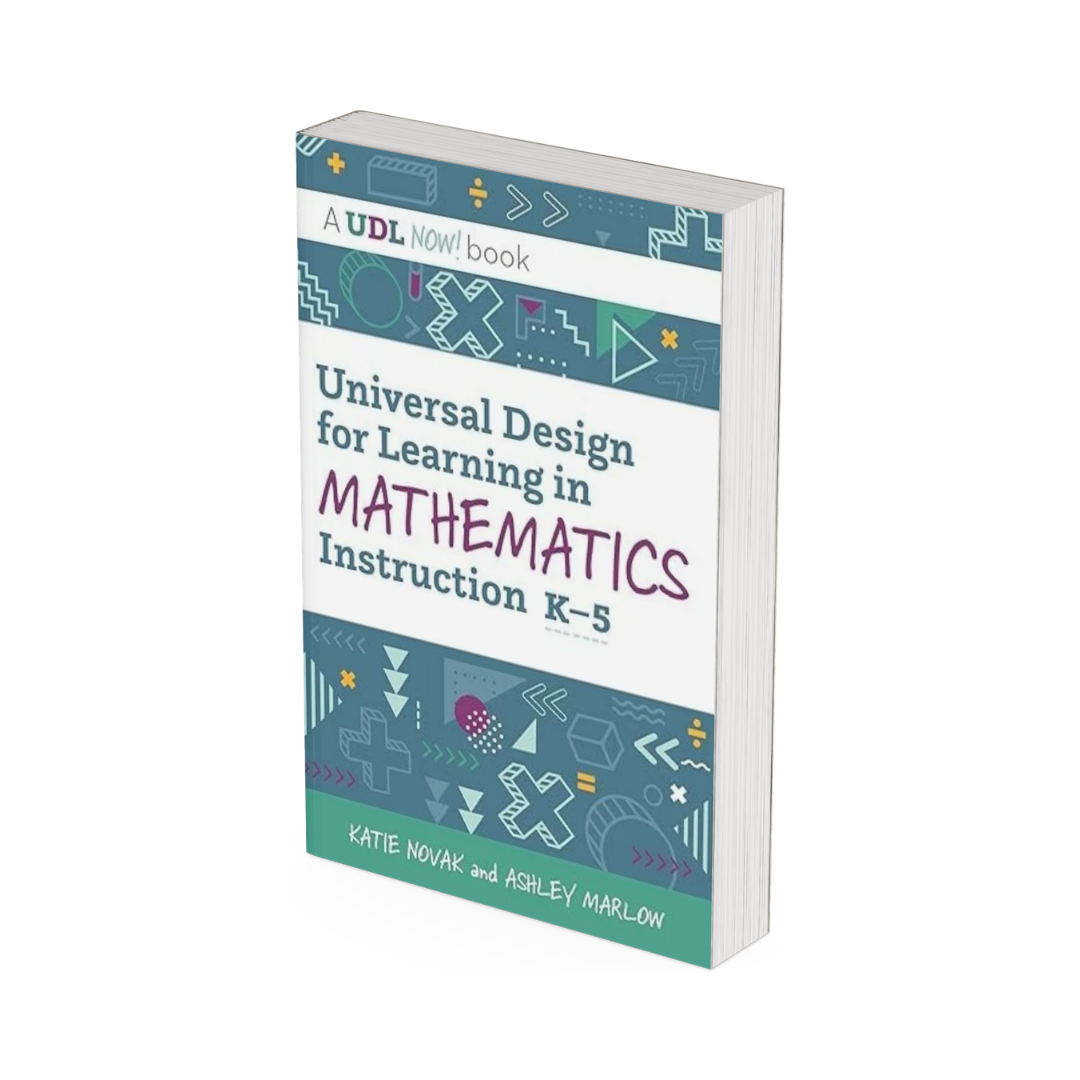

An elementary mathematics teacher's one-stop guide to fostering early numeracy, positive math mindsets, and deep understanding of key mathematical concepts through UDL.
In this fast-paced, engaging new title in the UDL Now! series, Katie Novak and Ashley Marlow apply their expertise in Universal Design for Learning (UDL) and equitable, inclusive instruction to the elementary math curriculum, answering questions from educators such as:
What can I do to improve the math learning experience for my students and for myself?
How do I create a math learning environment that sends the message that we are all capable mathematicians?
What support and additional professional learning would I benefit from to make this happen?
The authors build on the critical work of the Algebra Project and the research-based principles of UDL to show that we can-and must-offer rigorous mathematics learning to all K-5 learners. They deserve no less, and with creative, universally designed instruction, we can deliver on that fundamental civil right.
Universal Design for Learning in Mathematics Instruction should be required reading for all elementary math teachers who seek both theoretical and practical insights on making math more inclusive, engaging, and meaningful. Full of actionable steps, this essential resource is not just a book; it’s a call to action for teachers to rethink their approaches and embrace Universal Design for Learning (UDL)
It is past time we face the fact that too many of our students miss out on the joy and satisfaction of learning authentic mathematics. In Universal Design for Learning Mathematics Instruction K-5, Novak and Marlo describe mathematics instruction, teacher and student mindsets, and classroom culture that can foster success for all students. I believe the strength of this work are the clear and practical examples of UDL based instructional practices in the context of important grade level mathematical topics such as early numeracy, additive and multiplicative reasoning, and fractions. Universal Design for Learning Mathematics Instruction K-5 should be required reading for all K-5 math teachers and instructional leaders.